Dropshipping vs Affiliate Marketing: My Honest Experience After Trying Both

I still remember the night I sat at my laptop at 1 a.m., completely overwhelmed, typing the same phrase into Google over and over again dropshipping vs affiliate marketing. I had been reading about online business for months. I had watched the YouTube videos, skimmed the Reddit threads, and saved about forty browser tabs with titles like ‘How I Made $10,000 in 30 Days.’ But every article I found either gave me a generic comparison table with no soul behind it, or it was clearly written by someone who had never actually tried either model.
So I decided to do something different. I tried both.
Not in theory. Not by interviewing someone else. I personally built a dropshipping store, ran it for close to six months, then shifted my focus to affiliate marketing and gave that a real shot too. What you are reading right now is not a recycled comparison it is my actual experience, including the mistakes I made, the money I spent, and what I learned that no YouTube video ever told me.
If you are trying to decide between these two paths and wondering dropshipping vs affiliate marketing which one deserves your time and money I want you to get the most honest answer I can give.
What Is Dropshipping? (And Why I Tried It First)
When I first stumbled onto dropshipping, it felt like someone had handed me the secret to making money without the traditional headaches of retail. The idea is beautifully simple on the surface you set up an online store, list products from a supplier, and when a customer buys from you, the supplier ships the item directly to them. You never touch the inventory. You never rent a warehouse. You just collect the margin between what your customer paid and what your supplier charged you.
I was drawn to dropshipping first because it felt more like a ‘real business.’ I could build a branded Shopify store, run Facebook ads, and theoretically generate revenue within weeks. That speed was intoxicating. I spent my first weekend researching products on AliExpress and DSers, watching product research videos, and eventually launched a store selling home organisation gadgets.
What nobody told me upfront was that dropshipping is not passive at all. It is a customer-facing business. I had to handle order tracking emails, deal with delayed shipping complaints (items from China often took three to four weeks), manage returns, write product descriptions, and spend real money on ads every single day just to get traffic. The moment I paused the ad spend, the store went completely silent.
What Is Affiliate Marketing? (My Second Experiment)
After about five months of dropshipping, I was exhausted and barely breaking even. A friend of mine who runs a personal finance blog casually mentioned that he made more from affiliate commissions on one blog post than I made from my store in a whole week. I was skeptical, but curious.
Affiliate marketing works like this: you create content blog posts, YouTube videos, social media posts, newsletters that recommends products or services. Each product has a unique tracking link. When someone clicks your link and makes a purchase, you earn a commission. You never deal with inventory, shipping, refunds, or customer service. The brand handles all of that.
I started a niche blog in the personal productivity space, joined a few affiliate programs including Amazon Associates and some software-as-a-service tools that paid recurring commissions, and began writing SEO-focused content consistently. The first three months were humbling almost no traffic, almost no income. But something interesting started happening around month four. Articles I had written weeks earlier began ranking on Google, and the traffic started to compound. I woke up one morning to a $47 commission I had earned while I was asleep.
That feeling earning money from a piece of content I wrote two months ago was something I had never experienced with dropshipping. And it changed how I thought about online business entirely.
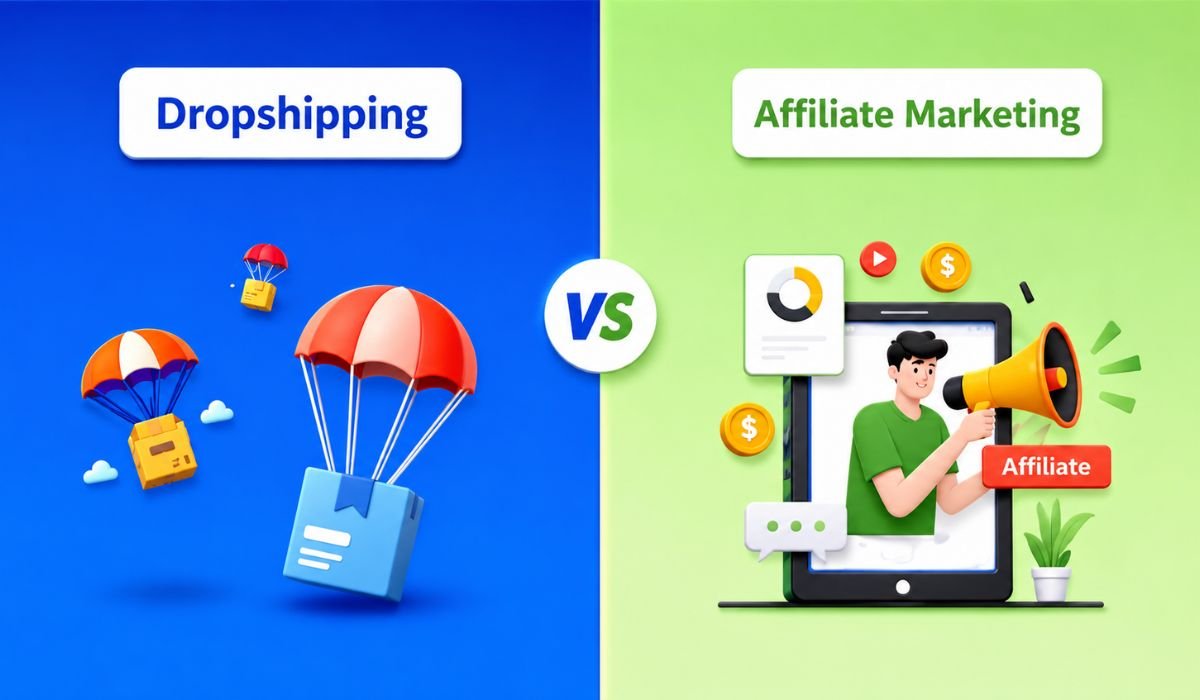
Dropshipping vs Affiliate Marketing The Real Differences
Business Model and Ownership
The most fundamental difference between these two paths is what you actually own and what you are responsible for. With dropshipping, you own the store and the customer relationship. You set the prices, create the brand, and bear the risk. If a customer is angry about a late shipment, they are angry at you even if the supplier is entirely to blame. You are the face of that transaction.
With affiliate marketing, you own the content and the audience. You are a middleman, yes but a strategic one. You build trust with readers or viewers, and you recommend products that genuinely help them. You earn a cut when they convert, but the product company handles fulfilment, returns, and support. This separation of responsibilities is why affiliate marketing feels so much lighter to operate day-to-day.
Who Does the Work?
In dropshipping, you are doing constant operational work ad management, customer emails, testing creatives, finding winning products, and fighting rising ad costs. The business demands your attention almost daily. In affiliate marketing, the heavy lifting is mostly upfront research, writing, and optimising content. Once an article or video ranks and generates traffic, it earns for you on autopilot. The work does not disappear but it front-loads rather than running daily.
Income Potential and Scalability
Dropshipping can generate higher short-term revenue if you find a winning product and scale your ads efficiently. I have seen people do six figures a month through dropshipping. However, margins are thin typically 15% to 35% after ad spend, product cost, and platform fees. Affiliate marketing tends to generate less raw revenue but at far better margins, especially when you promote software tools or financial products that pay recurring or high-ticket commissions. The ceiling for both is high, but the path there looks very different.
Here is a clear side-by-side look at how both models compare across the most important factors:
| Factor | Dropshipping | Affiliate Marketing |
| Business Model | Sell products, handle orders via supplier | Promote others’ products, earn commission |
| Product Ownership | No inventory, but you own the store | No product ownership at all |
| Customer Service | Yes you handle complaints & returns | No vendor handles everything |
| Revenue Type | Product margin (you set the price) | Fixed commission per sale/lead |
| Scaling | Harder ads, suppliers, support scale together | Easier content scales passively |
| Risk Level | Medium-High (ad spend, refunds) | Low-Medium (content effort upfront) |
Dropshipping vs Affiliate Marketing Cost What I Actually Spent
Let me be transparent about money, because this is where most comparisons go vague. I will share exactly what I spent during my own experiments with both models so you can make a realistic assessment rather than relying on best-case scenarios.
When I launched my dropshipping store, I budgeted what I thought was a reasonable $500 for my first month. By the end of that month, I had spent closer to $620 primarily on Facebook ads, Shopify fees, and a couple of apps for reviews and upsells. I generated about $780 in revenue but only $190 in gross profit after product costs. After platform fees, my net was closer to $140. My ads were not optimised yet, and I was essentially paying to learn.
When I switched to affiliate marketing, my monthly costs dropped dramatically. WordPress hosting through a budget provider cost me about $10 per month. I used a free keyword research tool initially before paying $29 per month for a basic SEO tool subscription. My total monthly spend was under $50. The trade-off, of course, was that I earned almost nothing for the first three months while my content built up traffic.
The table below gives you an honest breakdown of what I spent on each model so you can factor this into your own planning when considering dropshipping vs affiliate marketing cost:
| Expense | Dropshipping (My Cost) | Affiliate Marketing (My Cost) |
| Website / Store Setup | $29/month (Shopify Basic) | $10/month (WordPress + hosting) |
| Domain Name | $14/year | $14/year |
| Paid Advertising | $300–$500/month (Facebook/Google Ads) | $0 (organic SEO only to start) |
| Tools & Apps | $50–$80/month (DSers, Loox, etc.) | $20–$30/month (Ahrefs lite, email tool) |
| Product Research | $20/month (Minea or similar) | $0 (free keyword research tools) |
| Total Monthly (Approx.) | $400–$650/month | $44–$55/month |
| Time to First Revenue | 2–6 weeks (with ads) | 2–6 months (organic) |
The honest conclusion I drew from this is straightforward: dropshipping requires capital to generate results quickly, while affiliate marketing requires patience to generate results affordably. Neither model is inherently cheaper they just distribute their costs differently across time and money.
Which One Made Me More Money? (Honest Numbers)
I want to give you real numbers rather than polished success story statistics. In my first three months of dropshipping, I generated approximately $4,200 in total revenue. After ad spend, product costs, Shopify fees, and app subscriptions, I kept roughly $320 in net profit. That is not a typo. My effective profit margin was under 8%. I was working forty or fifty hours a month on the store and clearing less than minimum wage for my time.
By month four and five, I had optimised my ads a little better and found a second product that performed well. My net profit for month five was around $780. I was finally in positive territory, but I could feel the fragility of it one ad account issue, one supplier problem, or one Facebook policy change could wipe out everything overnight.
With affiliate marketing, months one through three earned me a combined total of about $90. I know how disappointing that sounds. But by month five, my monthly affiliate income had climbed to $420 entirely passive, with no ad spend, and growing consistently because my content kept accumulating search rankings. By month eight, I was earning over $1,100 per month from content I had already written, and that number continued to climb for months afterward without me creating anything new.
The numbers told me something important: dropshipping can make money faster but requires constant effort and capital to maintain. Affiliate marketing starts slowly but builds into something that genuinely earns while you sleep. Both are legitimate, but they serve different types of people.
Dropshipping vs Affiliate Marketing Pros and Cons From My Experience
Dropshipping: What I Loved and What Frustrated Me
The thing I genuinely loved about dropshipping was the sense of building a brand. I had a logo, a store name, product pages I had designed myself, and real customers making real purchases. There is something deeply satisfying about seeing orders come in. It also forced me to learn paid advertising, copywriting, and conversion rate optimisation skills that are valuable regardless of what business you run next.
What frustrated me constantly was the operational weight of it. Customer service emails arrived at all hours. Suppliers ran out of stock without warning. Ad performance would be excellent one week and collapse the next with no clear reason. I also felt a persistent anxiety about my entire business being one Facebook ad account ban away from disappearing. Platforms are unpredictable, and that is a very uncomfortable foundation to build on.
Affiliate Marketing: The Upside and the Patience It Demands
Affiliate marketing gave me something I had never experienced in business before genuine leverage. I wrote a 2,400-word review of a project management tool one Saturday afternoon. Eighteen months later, that article still earns me commissions every single week. I have not touched it in over a year. That kind of compounding return on effort is remarkable.
The downside is the timeline. If you need money in the next four weeks, affiliate marketing will not save you. You are planting seeds that take months to grow. I also learned fairly quickly that your income is tied to search rankings, which can shift due to Google algorithm updates. I had one article drop from page one to page three after a core update, and my income from that article dropped about 60% almost overnight. Diversification across multiple pieces of content and multiple traffic sources is essential.
How to Start Affiliate Marketing (The Way I Wish I Had)
Since I spent far too long fumbling around when I began, let me share how to start affiliate marketing in a way that actually works from day one. I am not going to give you a vague ‘pick a niche and start a blog’ answer. I want to give you what I wish someone had told me.
The first decision I should have made earlier was picking a niche that was narrow enough to rank in but broad enough to have genuine commercial interest. I initially chose ‘productivity tips’ which is far too competitive for a new site. What worked better was narrowing down to a specific tool category, like ‘project management software for freelancers.’ Specific beats broad every time in affiliate marketing.
After choosing your niche, the next step is selecting your platform. I recommend starting with a self-hosted WordPress blog because it gives you full control, looks professional, and is taken seriously by Google. Avoid free platforms for anything you intend to monetise seriously. Register your domain, set up a clean theme, and focus your energy on content from day one rather than endlessly tweaking design.
For affiliate programs, I suggest starting with two or three rather than ten. Amazon Associates is easy to join and covers almost any niche, but commissions are low (typically 1% to 4%). Software tools, online courses, and financial services offer commissions ranging from 20% to 50% or more often recurring. ShareASale, Impact, and CJ Affiliate are three networks where I have found excellent programs across a wide range of categories.
The content strategy that worked best for me was a mix of ‘best of’ roundups, direct product comparisons, and in-depth tutorials where affiliate tools were naturally part of the solution. These posts attract people who are already ready to make a decision, which means they convert far better than purely informational content.
Dropshipping vs Affiliate Marketing Which Is Better for You?
This is the question I searched for obsessively, and I now believe the honest answer is: neither model is universally better. The right model depends entirely on your personal situation your budget, your skills, your time, and what you actually want your business to feel like to run.
If you have capital to invest, enjoy fast feedback loops, and are willing to learn paid advertising, dropshipping offers a faster path to meaningful revenue. It is more like running a real e-commerce operation than it is passive income, and there is nothing wrong with that if that is what you want.
If you prefer building something sustainable with lower risk, enjoy writing or creating content, and can tolerate a slow ramp-up period, affiliate marketing is extraordinarily powerful over a twelve to twenty-four month horizon. The content you create today becomes an asset that earns for years.
The table below summarises which model I would personally recommend based on your specific situation and as someone who has genuinely tried both when considering dropshipping vs affiliate marketing which is better, I think this will help you make a much faster decision than I did:
| Your Situation | Go with Dropshipping | Go with Affiliate Marketing |
| Budget available | $500+ per month | Under $100 per month |
| Time availability | Full-time or part-time (10–20 hrs/week) | Consistent but flexible (5–10 hrs/week) |
| Skill set | Ads, product research, customer handling | Writing, SEO, content creation |
| Risk tolerance | Medium to high | Low to medium |
| Income timeline | Want faster results (with ad spend) | Fine with slow but passive income |
| Long-term goal | Build & potentially sell a brand | Build a content asset / authority site |
Are These Still Profitable Business Ideas in 2025?

One of the most common concerns I hear from people is that these models are saturated or that the window has closed. I want to address this directly because I think it is largely a myth and partly a legitimate concern, depending on how you approach it.
Both dropshipping and affiliate marketing remain genuinely profitable business ideas in 2025, but the bar for doing them well has risen compared to five years ago. The people who succeeded with dropshipping in 2018 by slapping AliExpress products on a generic Shopify store and running basic Facebook ads are finding it much harder now. Ad costs are higher. Competition is fiercer. Customers are more sophisticated about spotting cheap imports.
The dropshippers doing well today are building branded experiences, working with better suppliers, and creating content alongside their paid ads to build organic trust. They treat it as a real brand-building exercise, not a quick arbitrage play.
In affiliate marketing, the sites doing well are those that demonstrate genuine expertise and personal experience exactly the direction Google has been pushing with its helpful content updates. Sites that review products they have actually used, that offer real opinions rather than scraped summaries, and that build real audiences rather than chasing clicks are thriving. I have seen my own affiliate income grow because I leaned into this direction rather than fighting it.
I am personally still doing affiliate marketing. I walked away from dropshipping after about seven months because the operational demands did not suit my preferred working style. But I know people who are generating substantial income with dropshipping today and genuinely love the model. The opportunity is absolutely still there in both cases.
Final Verdict My Personal Recommendation
After everything I experienced testing both paths, here is my honest final take on dropshipping vs affiliate marketing:
If I were starting from scratch today with a $1,000 budget, strong writing skills, and no interest in running a customer service operation, I would go directly into affiliate marketing. I would find a specific niche, build a focused blog, and commit to twelve months of consistent content creation before expecting significant income. That patient approach, in my experience, builds something far more durable than a dropshipping store dependent on volatile ad platforms.
If I had a $2,000 budget, a competitive personality, and wanted to see results in weeks rather than months, I would try dropshipping but I would do it properly. That means choosing a niche with genuine demand, building a branded store rather than a generic one, starting with a small ad budget and optimising before scaling, and being mentally prepared for the operational side of running an e-commerce business.
My recommendation for most people who are new to online business and are genuinely uncertain? Start with affiliate marketing. The lower financial risk, the compounding nature of content, and the absence of customer service headaches make it a far more forgiving first business. Once you understand online marketing fundamentals through affiliate work traffic, conversions, copywriting, SEO you will be a far more effective dropshipper if you decide to pursue that later.
Can you do both at the same time? Technically yes, but I would not recommend it when you are starting out. Both models demand focused attention to get initial traction. Splitting your energy between them tends to mean doing both poorly rather than either one well. Pick one, go deep, learn from it, and then expand.
Conclusion
I started this journey confused and overwhelmed, exactly the way many of you might feel right now. After months of real experience with both models, I can tell you with confidence that both dropshipping and affiliate marketing are legitimate ways to build an online income but they reward very different types of people with very different resources and temperaments.
The most important thing I can tell you is this: stop researching and start doing. I spent three months reading about dropshipping vs affiliate marketing before I took a single real action. That was three months of potential learning and compounding that I simply lost to indecision. Whatever model resonates with you after reading this, take your first concrete step today. Register the domain. Set up the store. Write the first article. The learning that actually matters happens through doing, not through reading one more comparison article.
I hope my experience saves you some of the mistakes I made and shortens your path to finding what works for you. If you have questions about either model, drop them in the comments I genuinely enjoy these conversations.
Also Read About :- Online Business Ideas vs Traditional Business