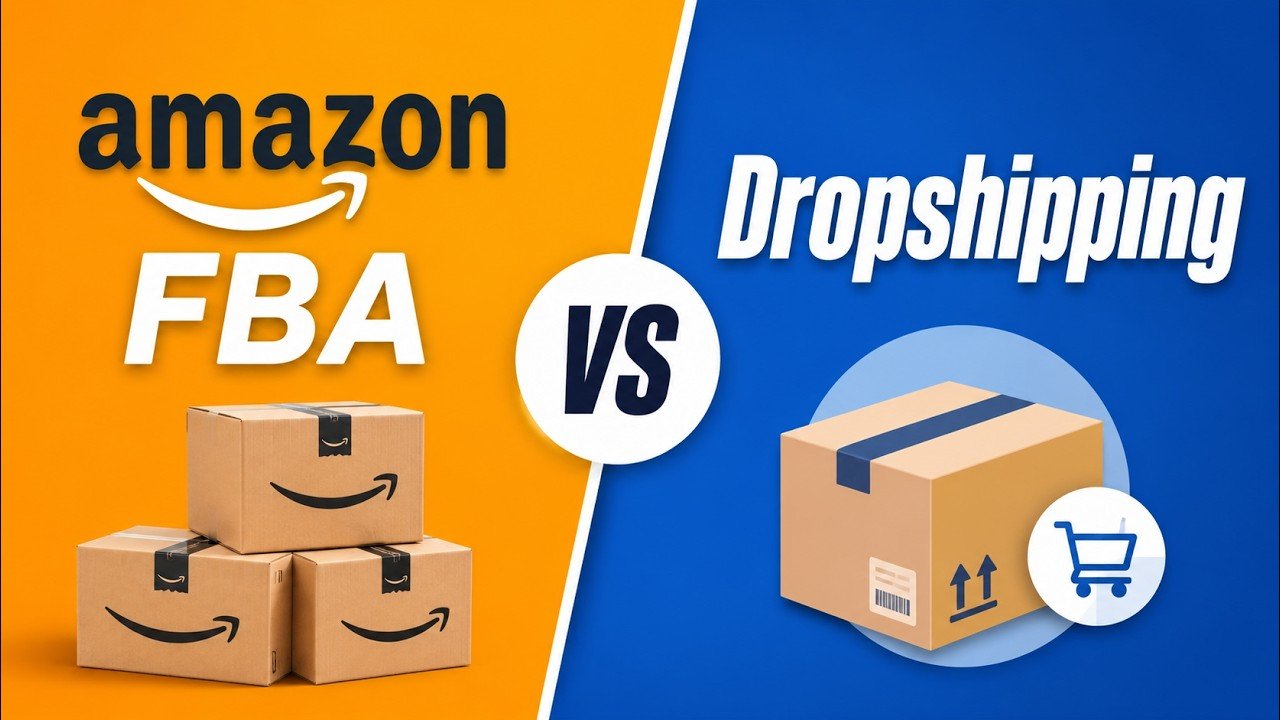

I still remember the night I sat at my kitchen table, laptop open, trying to decide which ecommerce path made more sense for someone with a small budget and zero warehouse space. Like a lot of people who go down this rabbit hole, I read dozens of “make money online” posts before realizing most of them were written by people who had never actually shipped a single product. So I did what felt right at the time I tried both models myself. I ran a private label store through Amazon’s fulfillment program, and a few months later I built a dropshipping store from scratch to see how the other side lived. This article is my real, lived-through comparison of amazon fba vs dropshipping, based on what actually happened to my bank account, not what a course salesman promised would happen.
If you’re trying to decide between the two right now, I want to save you the months of confusion I went through. I’ll walk you through what each model actually involves, what it cost me to start, what surprised me, and which one I’d genuinely recommend depending on your situation.
For context, I wasn’t coming from a background in retail or logistics. I had a regular job, a bit of savings, and a curiosity about whether all the buzz around ecommerce was actually grounded in reality. I went in expecting one of the two models to clearly “win,” and what I found instead was more complicated both businesses taught me things the other one couldn’t, and both came with trade-offs I didn’t fully appreciate until I was already a few months in.
What Is Amazon FBA? (Quick Breakdown Before We Compare)
Before I get into the comparison, it’s worth covering the basics for anyone landing here without much background. So, what is Amazon FBA? In plain terms, it stands for Fulfillment by Amazon. You source or manufacture a product, ship it in bulk to an Amazon warehouse, and Amazon takes care of storage, packing, shipping, and customer service once a sale comes in. You’re not touching the product after it leaves your hands Amazon’s fulfillment network does the heavy lifting.
When I first signed up, the appeal was obvious. I wasn’t going to be standing in my garage taping boxes every night after work. I uploaded my listing, sent my inventory to one of Amazon’s fulfillment centers, and from that point forward, every order was handled automatically. Becoming an amazon fba seller felt a lot more “real” to me than I expected there’s something different about seeing your own product show up with a Prime badge next to it.
That said, the program isn’t free, and it isn’t passive in the way influencers make it sound. There are storage fees, fulfillment fees per unit, and the constant pressure of keeping inventory balanced so you’re not paying for excess stock sitting in a warehouse. I learned that the hard way during my first holiday season, which I’ll get into later.
What Is Dropshipping? (The Model I Tried Right After)
After spending a year deep in the FBA world, I wanted to test something with a lower upfront cost, mostly out of curiosity about whether it could be just as profitable without tying up cash in inventory. So, what is dropshipping, exactly? It’s a retail model where you list products in your own online store, but you never actually hold any inventory yourself. When a customer orders from you, you forward that order to a third-party supplier, who ships the product directly to the customer under your branding (or sometimes without branding at all, depending on the supplier).
The appeal here was immediate. I didn’t need a warehouse, I didn’t need thousands of dollars sitting in stock, and I could test multiple products in the same week without committing financially to any of them. My first store was built on a weekend, and I had my first sale within ten days. It felt almost too easy compared to the slower, capital-heavy process of importing and shipping FBA inventory.
But easy to start doesn’t always mean easy to sustain, and that distinction became one of the biggest lessons from running both businesses side by side.
Amazon FBA vs Dropshipping: The Core Differences
Once I had run both models for a while, I started keeping a simple comparison sheet just for my own sanity, because the day-to-day experience of each business felt completely different even though both technically fall under “ecommerce.” On paper they look similar list a product, get a sale, ship it to a customer but the actual mechanics behind each step couldn’t be more different once you’re the one running it. Here’s a breakdown of what I noticed when comparing the two side by side:
| Factor | Amazon FBA | Dropshipping |
| Startup cost | Higher inventory, shipping, FBA fees | Low mainly store setup and ads |
| Control over branding | Limited by Amazon’s listing rules | More flexible, your own store and design |
| Fulfillment speed | Fast, Prime-eligible in most cases | Slower, depends entirely on the supplier |
| Profit margins | Moderate but more predictable | Thinner and more variable |
| Scalability | Easier once stock is moving | Easy to start, harder to scale cleanly |
| Customer trust | Built-in, thanks to Amazon’s reputation | You have to build trust yourself |
What this table doesn’t fully capture is how different the stress points are. With FBA, my anxiety came from inventory planning running out of stock during a sales spike, or overordering and bleeding money on storage fees. With dropshipping, my anxiety came from shipping times and supplier reliability. More than once, a supplier delayed an order without telling me, and I was the one fielding the angry email from the customer.
Neither model removed the stress of running a business. They just moved it to a different part of the process.
How Much Does It Cost to Start? (Real Numbers From My Experience)
This is the section I wish someone had been honest with me about before I started. My first FBA product cost me a few thousand dollars just to get off the ground that included a bulk order of inventory, shipping it from the manufacturer to Amazon’s warehouse, basic product photography, and some initial advertising to get the listing moving. I want to be clear that this wasn’t even a particularly expensive product category. Inventory-heavy businesses simply require cash upfront, and there’s no way around that.
Before committing to that first order, I ran the numbers through an amazon fba calculator to estimate what my actual profit per unit would look like after Amazon’s fees, shipping costs, and advertising spend were factored in. I’d genuinely recommend doing this before ordering a single unit, because the margin on paper often looks better than the margin in reality once all the small fees are subtracted. I underestimated storage fees in my first attempt, and that one miscalculation ate into a chunk of my early profit. The calculator didn’t fix that mistake, but it did help me understand exactly where my margin was leaking once I went back and re-ran the numbers with real fee data instead of rough estimates.
Dropshipping, by comparison, cost me only a few hundred dollars to start mostly the store platform subscription, a basic theme, and a small initial ad budget to test which products might sell. I didn’t need to buy a single unit of inventory upfront. That low barrier is exactly why so many beginners gravitate toward it, myself included at the time. The catch is that low startup cost often comes with thinner margins, since you’re typically paying more per unit to a supplier than you would buying in bulk for FBA. I also found that the “low cost” framing can be misleading once ad spend ramps up testing several products in a short window meant my advertising budget grew faster than I expected, even though I never touched inventory costs at all.
How to Start Dropshipping (What Actually Worked for Me)
When people ask me how to start dropshipping, I usually tell them the technical setup is the easy part the hard part is everything that happens after the store goes live. I started by picking a niche I had some personal interest in, mostly because I knew I’d need to write product descriptions and run ads for it constantly, and being bored of your own niche within two weeks is a fast way to give up.
From there, I built the store itself, which took less time than expected once I had a platform and a basic theme picked out. I spent more time vetting suppliers than building the store, because I’d read enough horror stories about products arriving weeks late or looking nothing like the photos. Once I had a small handful of products listed, I ran a modest ad budget to test interest before scaling up spend on anything.
The biggest shift in my mindset came when I stopped treating it like a “set it and forget it” side hustle and started treating it like an actual retail business. Customer service, return requests, and chasing suppliers for shipping updates ate up far more of my time than the marketing side ever did. Anyone going in expecting a hands-off income stream is going to be surprised by how much day-to-day involvement it actually takes, especially in the first few months while you’re still figuring out which products and suppliers are reliable.
Where to Find Reliable Dropshipping Suppliers
Finding decent dropshipping suppliers was honestly the most frustrating part of the entire process for me. My first few suppliers were sourced through general marketplaces, and while pricing looked attractive, shipping times were inconsistent and communication was slow whenever something went wrong with an order.
Eventually I moved toward suppliers that specialized in faster regional shipping and offered better communication channels, even though their per-unit pricing was slightly higher. That trade-off ended up being worth it, because customer complaints dropped significantly once delivery times became more predictable. I also started ordering sample products myself before listing anything, just to check quality firsthand rather than trusting photos alone.
If there’s one thing I’d tell my past self, it’s to never list a product from a supplier I hadn’t personally tested. A few of my early refund requests came directly from products that looked fine in photos but felt cheap or broke easily once they arrived. Supplier reliability, more than marketing skill, ended up being the real make-or-break factor in how smoothly my dropshipping store ran.
Amazon FBA Seller Life: What Nobody Tells You
Running an FBA Amazon account looks polished from the outside, but there’s a layer of operational stress that doesn’t show up in most success-story posts. Storage fees were the first surprise Amazon charges for the space your inventory takes up in their warehouse, and those fees increase the longer your stock sits unsold, especially around certain peak periods of the year. I learned this the expensive way after overestimating demand for a seasonal product.
Account health was another ongoing concern. A handful of negative reviews, a shipping delay outside of my control, or even a policy violation I didn’t fully understand could put restrictions on my account. Unlike a personal store where I controlled every variable, I was operating inside someone else’s platform, with someone else’s rules, and those rules occasionally changed with little warning.
Returns added another layer I hadn’t fully planned for. Even though Amazon handles the logistics of a return, the cost of a returned or damaged unit still comes out of my margin, and certain categories see return rates high enough to noticeably affect monthly profit if you’re not tracking them closely. I started reviewing my return data every few weeks just to catch patterns early, like a specific size or variation generating more complaints than the rest of my catalog.
Competition was the third pressure point. As more sellers entered similar categories, particularly from manufacturers selling directly at lower margins, pricing pressure increased steadily. I had to keep refining my listings, adjusting pricing, and occasionally reordering smaller batches of inventory instead of large bulk orders, just to stay flexible. None of this made FBA a bad business it just made it a far more hands-on business than the “passive income” framing usually suggests.
Profit Margins & Scalability: Which Model Actually Made Me More Money
This is the question everyone really wants answered when they ask about amazon fba vs dropshipping, so I’ll be direct about it. Over a comparable stretch of time, my FBA business produced steadier, more predictable monthly profit once I got the inventory cycle figured out. The margins per unit were healthier because I was buying in bulk directly from a manufacturer rather than paying a markup to a dropshipping supplier on every single order.
Dropshipping, on the other hand, had higher highs and lower lows. Some weeks, a winning product would bring in solid profit with very little effort. Other weeks, rising ad costs would eat almost the entire margin on a product that was selling just fine in terms of volume. Scaling dropshipping responsibly meant constantly testing new products, because winning products tend to get saturated quickly once other sellers notice the same trend.
If I’m being completely honest about where I reinvested my own money, it went back into the FBA side more often, simply because the margin per sale gave me more breathing room to scale without constantly chasing new products. That doesn’t mean dropshipping was a failure it taught me marketing skills I still use today but it required more constant attention to stay profitable at scale.
Is Dropshipping Worth It in 2026? My Honest Verdict
I get asked is dropshipping worth it more than almost any other question related to this topic, and my answer has gotten more nuanced over time. A few years ago, ad costs were lower and competition in a lot of niches was thinner, which made it easier to find a profitable angle quickly. Now, with so many stores running similar products and rising advertising costs across most platforms, the margin for error is smaller than it used to be.
That said, I don’t think it’s dead, and I’d push back on anyone who says it can’t work anymore. It’s just less forgiving for beginners who treat it as a get-rich-quick scheme rather than an actual retail business that requires customer service, supplier vetting, and consistent testing. The people I’ve seen succeed with it long-term treat it closer to running a real store than running a side hustle.
If you’re going into it expecting a guaranteed outcome within the first month, I’d manage those expectations now rather than later. It can absolutely still be worth it, but the version of dropshipping that works in 2026 looks more like disciplined, ongoing testing than a one-time setup that runs itself.
One thing that changed my own results was narrowing down to a smaller, more specific niche instead of trying to run a general store with dozens of unrelated products. When I spread myself across too many categories early on, my ad spend got diluted and I couldn’t build any real brand recognition. Once I tightened the focus, the same ad budget went noticeably further, simply because I was talking to the same type of customer consistently instead of starting from scratch with every new product.
Amazon FBA vs Dropshipping: Which One Should You Choose?
After running both, my honest recommendation depends entirely on your starting point. If you have some capital to invest upfront and you’re comfortable with the idea of holding inventory, I’d lean toward FBA for the more predictable margins and built-in customer trust that comes from selling on Amazon. If your budget is tighter and you want to test ideas before committing real money to inventory, dropshipping gives you that flexibility, even if the margins are thinner.
| Your Situation | Better Starting Point |
| Limited budget, want to test ideas first | Dropshipping |
| Some capital available, want steadier margins | Amazon FBA |
| Comfortable managing inventory and logistics | Amazon FBA |
| Want full control over branding and store design | Dropshipping |
| Prioritizing speed of delivery for customers | Amazon FBA |
There’s also nothing stopping you from doing what I eventually did, which is running both at different points to see which one fits your working style better. I learned more about ecommerce in general by comparing the two directly than I would have by sticking to just one from the start.
Frequently Asked Questions
Yes, plenty of sellers run both. I did exactly this for a stretch of time, using FBA for my main product line and dropshipping as a lower-risk way to test new product ideas before committing real inventory budget to them.
Dropshipping tends to be friendlier for absolute beginners because the upfront cost is lower and there’s less financial risk if a product doesn’t sell. FBA has a steeper learning curve around inventory and fees, but it can produce more predictable margins once you’re past that curve.
It depends on where you live and how seriously you plan to scale, so I’d recommend checking current local and platform-specific requirements rather than relying on general advice here, since rules can vary and change.
This varies enormously based on product choice, ad spend, and supplier reliability. In my own experience, the first few months were closer to breaking even while I learned what worked, and meaningful profit came after that initial testing period.
It can be, but FBA Amazon fees have crept up compared to a few years ago. Running your numbers through an Amazon FBA calculator before committing to inventory is the best way to know whether a specific product still makes sense for you.
In my experience, it’s underestimating how much ongoing work is involved. People see the word “automated” attached to FBA fulfillment or dropshipping order forwarding and assume the business runs itself. In reality, both still require active decision-making around pricing, inventory, supplier issues, and customer service almost every week.
Final Thoughts: My Personal Recommendation
If you’ve read this far, you already know I don’t think there’s a universal winner between FBA and dropshipping there’s only a better fit for your specific situation. I lean toward FBA for anyone who wants steadier margins and is willing to put capital into inventory upfront. I lean toward dropshipping for anyone who wants to test the waters of ecommerce without a big financial commitment, as long as they go in treating it like a real business rather than a shortcut.
What I can say with confidence, after running both, is that neither model is passive. Both took real effort, real mistakes, and real adjustments before either one became consistently profitable for me. Whichever path you choose, go in with realistic expectations, do the math before you spend, and don’t be afraid to pivot if the first few months don’t go the way you hoped.
Looking back, I don’t regret the time I spent on either business, even the months that lost me money. Each one taught me something the other couldn’t, and honestly, that combined experience is the only reason I’m able to write a comparison like this with any real confidence instead of just repeating what I read somewhere else.
Also Read About :- Shop101 Business Plan: My Honest Experience